


This article is an on-site version of our Chris Giles on Central Banks newsletter. Premium subscribers can sign up here to get the newsletter delivered every Tuesday. Standard subscribers can upgrade to Premium here, or explore all FT newsletters
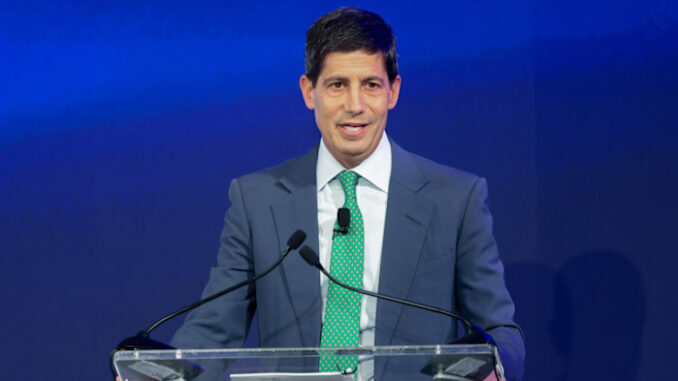
Kevin Warsh will make the case in front of the Senate Committee on Banking, Housing and Urban Affairs today that he is the right person to become US Federal Reserve chair. But there are many hurdles he needs to clear before he takes the most important job in central banking.
Will Warsh’s undisclosed financial investments prove an obstacle? Will Republican senator Thom Tillis continue to block Warsh until the criminal probe into Fed chair Jay Powell is dropped? Will the Department of Justice drop that probe to smooth the path for Warsh? Will President Donald Trump fire Powell if he remains chair after his term ends on May 15? How quickly will a judge throw out any such attempt? Will the president seek to nominate a different chair in the interim? Will the rate-setting Federal Open Market Committee keep Powell as chair even if Trump nominates a new temporary one?
I am not going to attempt to answer any of these questions because, frankly, I don’t know what will happen. But I am going to make one assertion: ultimately, these questions will prove transitory. I want to focus on more substantive points regarding the nomination, which I hope the committee will probe.

I have been delving into Warsh’s past views for benchmarks against which we can judge positions he will lay out in his hearing. All of my research tallies with Warsh’s opening statement, which came out last night. Consistency is thus something the Fed chair nominee clearly values. For Warsh’s views as a Fed governor between 2006 and 2011, I have made liberal use of a helpful AI tool, which limits its search domain to Fed archives.
Will Warsh be Trump’s lackey?
In the past, Warsh has had a sophisticated, consistent view on central bank independence. He has made the case that independence is a wise outcome of the political process, but that central bankers need to reciprocate with good economic outcomes. They should not be “treated as pampered princes”, nor see independence as “some inalienable right, some entitlement”. Rather, it is “a revocable privilege”.
Giving evidence to a UK House of Lords committee in 2023, he said: “Independence granted by government demands a few other things. It demands that the central bank also acts independently without favour to any one side.”
There will naturally be some scepticism about Warsh on this front — not because he is a Republican but because he was highly partisan when angling for the nomination. In November last year, he wrote: “The most underappreciated characteristic of the Trump administration is its admiration for individual achievement. Treating people based on their merits rather than their status or sensibilities is the renewed American credo.” This does not sit well with the evidence of Trump’s transactional capitalism, which favours loyalists.
The hearing will be an opportunity for Warsh to demonstrate some distance between himself and the administration.
Does an energy shock require tighter monetary policy?
In 2011, Warsh’s answer was broadly “yes”. At a November 2011 FOMC meeting, he questioned whether staff forecasts in the Fed’s “Tealbook” were right to assume commodity prices would fall in line with futures pricing. He was also “less certain” than the staff that “movements in the prices of energy and imports would only have minor implications for domestic inflation”. Instead, higher commodity prices would “find their way into sales prices”, he said, with loose monetary policy encouraging higher inflation expectations. His views 15 years ago were similar to those expressed by Fed governor Christopher Waller on Friday.
Although he disagreed with the chair and the rest of the committee on their monetary policy stance at the 2011 meeting, he did not formally dissent. The question today is whether he has changed his mind about energy shocks and, if so, why.
Where should interest rates go?
Trump said last week (11 mins) that interest rates would fall “when Kevin gets in”, despite Treasury secretary Scott Bessent saying the central bank was “doing the right thing by sitting and watching”.
Warsh made clear his view that lower rates were needed last November. But this came as part of a package alongside tighter financial conditions for Wall Street, so was more of a redistribution of the effects of monetary policy rather than a simple loosening.
He also said a coming productivity boom would be a “significant disinflationary force”, implying a bias towards easier policy based on the conviction that AI would lower inflationary pressures.
We need to know why he disagrees with the many economists, including Fed officials, who think a productivity boom implies structurally higher interest rates to generate the additional savings needed to balance the AI investment surge.
What is Warsh’s theory of inflation?
Warsh is fond of saying “inflation is a choice”, which occurs when the US government “spends too much and prints too much” and which the central bank allows to happen. Questions regarding the Trump administration’s fiscal loosening and high budget deficits will, therefore, be interesting.
It is also true that Warsh has held multiple theories of inflation. He thinks the Fed erred in thinking that having a price stability objective was sufficient to make low inflation a reality. He also thinks it believed its models too much and that it allowed excessive money creation. These are compatible with Warsh’s core belief that government spending and money-printing is the root of inflation. But it will be interesting to know how he links them in a coherent theory.
What does Warsh really think about the Fed’s balance sheet?
Warsh has long opposed the rise in the Fed’s now $6.7tn balance sheet, which he blames for fostering inflation, blurring the boundaries between fiscal and monetary policy and undermining central bank independence.
These are the things we want to know: how quickly does he want to move from a rising to a shrinking balance sheet? Is changing banking regulation so financial institutions want to hold US government bonds rather than reserves at the Fed the primary lever he will pull? What difference would that make? If the private sector were encouraged to buy more government bonds, would that require higher yields? If interest rates were cut in return, who are the winners and losers?
This is perhaps the policy that will define the Warsh Fed.
Will Warsh seek deference from other Fed officials?
Before he quit as a Fed governor in 2011, Warsh made clear he disagreed with the central bank’s policy. But he did not dissent against the then chair, Ben Bernanke. The transcript of the November 2010 FOMC meeting shows Warsh telling Bernanke that he was leading the committee in the wrong direction, but that “this is called the Bernanke Fed for a reason” and “I wouldn’t want to undermine at this important moment the chance that this [QE] program could be successful”.
Warsh in 2023 also noted that “the chairman at the Federal Reserve has an inordinate say over the final votes”. The question, then, is whether he will demand the deference of others on the FOMC that he showed Bernanke.
Warsh’s attitude to theory, conviction and data
Warsh has long been an economist strong on conviction, as is clear from his views on government spending and money-printing. Yet he has generally been sceptical in the past of being data-dependent. The problem with data dependence, he told UK lords in 2023, is that “the data is not very good” and “dependence says ‘we’re going to make policy based on old data’”.
One thing is certain: Warsh wants the Fed to look at more real-time information. But this raises questions about how he wants to use these rather noisy new datasets and what the movements that would force a change of view would be.
Warsh and the relationship between the Fed and US Treasury
In something that surprises many Americans, Warsh has long seen little problem in the US Treasury having a say on monetary policy. “The Fed is not independent from government. It is independent within government,” he said in a 2010 speech.
His view is essentially the one adopted in Britain, where a UK Treasury representative attends meetings of the Monetary Policy Committee and the Bank of England only has operational independence from government for certain prescribed roles. In 2023, Warsh said this of the UK: “My bias was, ‘boy, that must be quite the intrusion. The Treasury secretary doesn’t sit at the Federal Reserve’, but I was surprised and delighted at how well the culture works.”
What is not known is whether he just admires the UK from afar or wants to give the US executive a greater say.
Warsh on financial regulation, crypto and stablecoins
One area Warsh is clear the Fed should not be independent is in financial regulation. “I do not believe the Fed is owed any particular deference in bank regulatory and supervisory policy,” he said last year.
This is a broadly principled position. In fact, BoE governor Andrew Bailey last week made similar arguments. But it does raise the question of how the Fed will view financial stability risk from banks, crypto and stablecoins when the administration is in favour of deregulation.
Warsh on communications
Warsh has made clear his distaste for a cacophony of voices on monetary policy. “I would say that communications are important, but we should not be talking so much,” he said to the UK parliament. In the same hearing, he advocated fewer monetary policy meetings.
“Once policymakers reveal their economic forecast, they can become prisoners of their own words,” he later said in 2025, which explains his dislike of the FOMC’s dot plots. The questions that matter here are how quickly Warsh would like to bring in reforms and what they would entail.
What I’ve been reading and watching
If you want a great primer about stablecoins, which recognises costs and benefits and avoids tech bro jargon, read the speech this week by the Bank for International Settlements general manager, Pablo Hernández de Cos.
The greatest threat to the global economy would come from the Iranian regime realising the Strait of Hormuz is more powerful than a nuclear weapon or missiles. Our reporting from Tehran suggests this is exactly the lesson being learnt.
At Monetary Policy Radar, we have developed a new real-time measure of household inflation expectations from posts on X. The good news is that they moderated a bit in April.
Did you know the European Central Bank has its own art collection? That is the question it asked on social media last week. If you are in Frankfurt on April 25, you can see it as long as you register before Wednesday.
One last chart
Last week, the IMF urged countries not to subsidise fuel or lower energy taxes that made adjustment to the Iran supply shock more difficult. Many governments simply ignored it, as the chart below shows. These countries include those that have made a virtue of international co-ordination, such as Canada, where Prime Minister Mark Carney announced the suspension of fuel duties until September.
Central Banks is edited by Harvey Nriapia
Recommended newsletters for you
Free Lunch — Your guide to the global economic policy debate. Sign up here
The Lex Newsletter — Lex, our investment column, breaks down the week’s key themes, with analysis by award-winning writers. Sign up here


Be the first to comment