


When Spirit Airlines shut down before dawn on May 2, work for pilot Steve Giordano was just beginning.
Giordano, managing partner of the Nomadic Aviation Group, told CNBC he organized a massive repossession of more than 20 Spirit planes that lessors wanted returned.
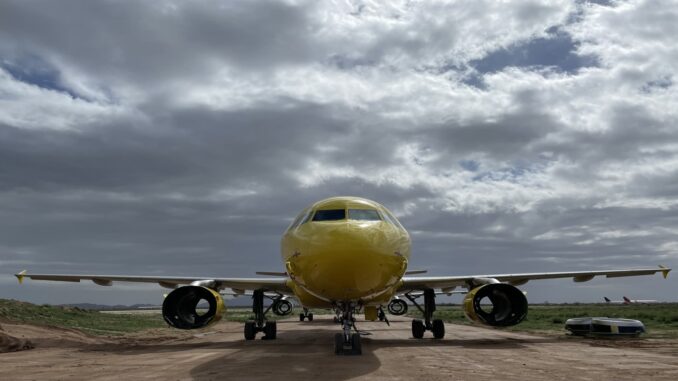
In just over a week, he said he and his team ferried 23 Spirit planes from airports around the country to the Arizona desert. Just hours earlier, those bright yellow Airbus jets had been flying Spirit customers.

Giordano, who runs Nomadic with co-founder Bob Allen, was starting to hear in the late morning on May 1 that his team would be at work soon. “We finally got the trigger pulled to start moving crews at 6 p.m.” on May 1, he said. Spirit shut down at 3 a.m. ET the next morning.
So Nomadic and hired pilots — some of whom were previously flying for Spirit — began ferrying the aircraft out West with no customers on board to special airports outside of Phoenix and Tuscon, Arizona, where they’ll be stored for now.
Retired or otherwise unused aircraft are often parked out in the desert because the climate reduces the risk of corrosion or other damage. Airlines parked thousands of them there when travel collapsed in the Covid pandemic.
Repossessing aircraft
A retired Spirit Airlines Airbus plane in Coolidge, Arizona, in February 2023.
Leslie Josephs/CNBC
Nomadic organizes everything from getting fuel for the planes it’s flying to ensuring the aircraft have necessary inspections and crews for the flights.
Unlike with an airline that has a large staff of dispatchers, mechanics and pilots, “when you’re out on a mission like this, there’s a lot more responsibility as far as getting the mission accomplished,” Giordano told CNBC. “To be honest, the easy part of this is the flying part of it.”
Nomadic is a specialist in aviation. The company typically transports aircraft to new customers around the world. Rarely, the company’s work also means repossessing planes for leasing firms or other owners when an airline liquidates.
“It’s certainly the least frequent type of operation that we do,” Giordano said.
Major airline shutdowns in the U.S. are rare, and Spirit’s collapse was the biggest in decades. Earlier this month, Spirit began the long process of dismantling the discount carrier in bankruptcy court.
Part of that liquidation process involves returning planes to the lessors, which is where Nomadic Aviation comes in. According to a court filing, Spirit had 114 Airbus A320 planes, and 66 of them were leased.
Giordano said he was so busy before one Spirit repossession flight that he forgot to eat.
“By the time I got to the airplane, I’m like, ‘Oh no, I’m really hungry and there’s not going to be any options until we get to Arizona,'” Giordano said. “One of the mechanics said, ‘Hey, all the galley carts are full.’ So it had all the normal Spirit snacks. I think I had some Milano cookies. … I had a couple snack boxes with cheese. It was basically free and unlimited.”
Not everything was free for the taking, like Wi-Fi.
“I had to pay for it, but it worked,” he said of the Spirit plane he ferried from Philadelphia International Airport to Pinal County Airport in Marana, Arizona.
In demand
A Spirit Airlines Airbus A320 parked at LaGuardia Airport in New York days after the carrier ceased operations.
Leslie Josephs/CNBC
It isn’t clear where each plane that was in Spirit’s fleet will end up. The carrier had already reduced its fleet in recent years and cut routes to save cash.
Engines that weren’t part of a major Pratt & Whitney recall, which grounded Spirit’s jets and hurt the airline years before it even filed for bankruptcy, could be in high demand.
A Pratt & Whitney PW1127G engine was going for about $14.5 million in January, up from $11.3 million three years earlier, according to aviation consulting firm IBA Group.
Supply chain shortfalls since Covid have lifted values of secondhand parts, none more valuable than engines, though there are hundreds of components that make up an aircraft and can be sold.
“The engines that were operational will be very welcomed,” said Stuart Hatcher, IBA’s chief economist. “The turnaround time at the shops is still probably close to double what it should be.”
Giordano who lives not far from the Philadelphia airport, said it was “surreal” driving to work to fly the last Spirit plane out of that airport.
“This is the last time this will ever happen, and I happen to be flying it,” he said.


Be the first to comment