


Hello, this is Priyanka Salve, writing to you from India.
Welcome to the latest edition of “Inside India” — your one-stop destination for stories and developments from the world’s fastest-growing large economy.
After months of being weighed down by high energy prices, trade uncertainty and foreign investor exodus, India has had plenty to celebrate this Diwali. Foreign investors returned to its market in November and, now, it seems the long-awaited U.S.-India trade deal could be around the corner.
Experts say that the two sides are closer to signing on the dotted line following the U.S. midterm election results than they were before.

Any thoughts on today’s newsletter? Share them with the team.
The big story
The U.S.-India trade deal, which has been riddled with uncertainty since February, is likely to get a final push to the finish line, thanks to U.S. President Donald Trump’s electoral setback in the midterm polls.
Experts told CNBC that Trump could lean toward closing some of the pending trade deals to promote them as policy achievements to the American public, and the pact with New Delhi is a “prime candidate.”
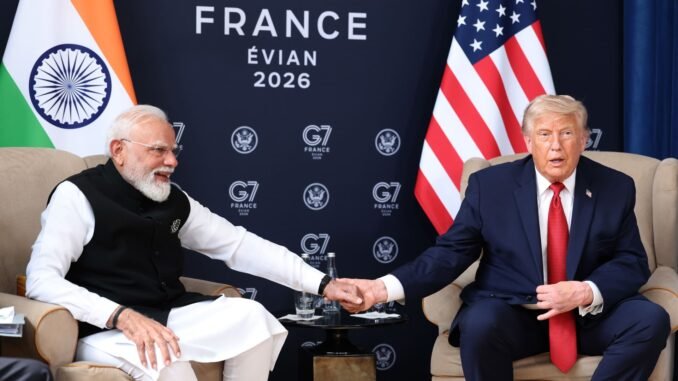
They added that Trump and Indian Prime Minister Modi are likely to sign the trade pact when they meet in December for the G20 leaders meeting, as negotiations have largely concluded.
EVIAN-LES-BAINS, FRANCE – JUNE 17: U.S. President Donald Trump (C-R) shakes hands with Indian Prime Minister Narendra Modi during a bilateral meeting at the G7 Summit on June 17, 2026 in Evian-les-Bains, France.
Anna Moneymaker | Getty Images News | Getty Images
The U.S.-India trade talks “are far along and there seems to be a gentlemen’s agreement between Trump and Modi” that the deal should be concluded when the two meet at Mar-a-Lago in December, Mark Linscott, former assistant U.S. trade representative and senior advisor at the U.S.-India Strategic Partnership Forum, told CNBC.
Trump has used tariffs as a pressure tactic to clinch trade deals with several countries, even as that approach has drawn the ire of his political opponents who have flagged that export levies have increased costs for American households. Cost of living was the top concern for American voters in the midterms.
“The election was a verdict on the cost of living, and tariffs are now a liability the President cannot defend on the numbers,” Ronak D. Desai, visiting fellow at Hoover Institution of Stanford University, told CNBC.
“Congress will not hand him an affordability win, but a trade deal is one he can announce on his own,” Desai said, adding that an announcement of a deal with India is “more likely than it was before the election.”
India’s commerce and external affairs ministries and the U.S. Trade Representative’s Office did not respond to CNBC’s requests for comment.
When asked about how U.S. midterm election results will reshape the ties with New Delhi, a spokesperson for India’s Ministry of External Affairs on Tuesday said that the relationship between the two countries “enjoys bipartisan support in the United States.”
Hard bargain
Trump insists Americans do not share the burden of his tariffs, but according to estimates from Tax Foundation, a nonprofit, the duties raised the average U.S. household’s tax burden by $820 in 2026 and $1,000 in 2025.
As a result, the Democrats, within days of taking control of both the houses of Congress are preparing to challenge Trump’s signature tariff policy. A trade deal at this time could be seen as a validation of Trump’s tariffs-led approach to business.
“The president may lean more into getting deals done – seeing them as policy achievements that he can promote to the American public,” Atman Trivedi, partner at Washington-based DGA Albright Stonebridge Group, told CNBC. He added that the Trump administration would like to get a deal done with India by the G20 leaders’ summit in December.
While American voters are more affected by import duties on Canadian goods, experts said that a trade deal with India could blunt criticism about tariffs as an effective bargaining chip.
In February, Trump announced a deal with India, claiming that New Delhi had agreed to “Buy American” at a much higher level after the U.S. agreed to slash tariffs to 18%. Trump had earlier imposed a 25% tariff on imports from India, along with an additional 25% duty on goods from New Delhi for buying Russian oil.
But that deal has since been awaiting final approval, especially after the Supreme Court struck down Trump tariffs, giving India space to demand preferential tariffs that give it an edge over competitors.
While American and Indian officials at the start of October said that the negotiations had reached an impasse, Trump on Oct. 20 said that the two sides were “pretty close” to a final deal. As per Indian media reports, the country’s Commerce Minister Piyush Goyal confirmed that discussions on the trade deal had largely “concluded.”
“We have been hearing for weeks that a deal is close to be settled,” Aryan D’Rozario, associate fellow and chair on India and Emerging Asia Economics at the Center for Strategic and International Studies, told CNBC, adding that Modi’s visit to the G20 summit in December “will provide the perfect stage to formalize an agreement.”
Need to know.
India as an AI hedge? The country’s stocks could see robust inflows as markets globally tankThe Indian stock market is emerging as an attractive hedge as investors seek refuge from a brutal sell-off in the artificial intelligence trade, making it a strong contender for global capital. If global investors “neutralize” their underweight positions on India, it could lead to foreign inflows of $115 billion, as per JPMorgan.
India billionaire Adani’s firm buys Dutch firm Evos to gain foothold in EuropeAdani Ports and Special Economic Zone, India’s largest port operator, will acquire Netherlands-headquartered Evos from Igneo Infrastructure Partners in an all-cash deal at an enterprise value of 2.56 billion euros.
Coming up
Nov. 12: India CPI inflation for October.
Nov.15: India unemployment rate for October.


Be the first to comment