

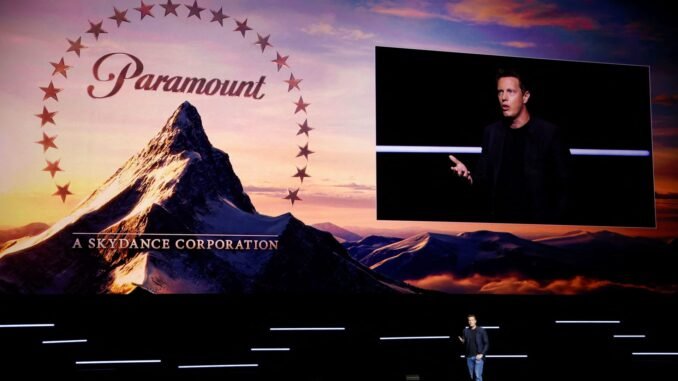

Paramount Skydance’s $110 billion merger with Warner Bros. Discovery will move forward as the company settled Monday with a group of state attorneys general that sought to block the deal on antitrust grounds.
The lawsuit, brought by a group led by California’s Rob Bonta, was previously set to head to trial in March and would have left the deal in limbo through mid-2027.
“We are grateful to Attorney General Bonta and his fellow AGs, as well as the WGA, for engaging in good faith to find a path forward to a resolution that serves all parties, and to Governor Newsom for his support throughout this process,” Paramount CEO David Ellison said in a statement Monday. “Our shared aim was an outcome that best serves consumers, workers and — most importantly — the creative community so vital to the art of visual storytelling.”
The acquisition will bring together two storied film studios, Paramount and Warner Bros. Discovery; a portfolio of TV networks; broadcast network CBS; and two popular streaming services in Paramount+ and HBO Max. The agreement Monday follows backlash from not only the state officials, but also the Writers Guild of America union and prominent actors and directors, who shared concerns about the effects on the U.S. film industry and creative roles.

Bonta detailed the terms of the agreement during a press conference Monday, but noted that “the settlement is not a vote of support for this merger.”
“It’s not a blessing of the broader merger,” he said. “Broadly speaking, we believe further consolidation in markets that are central to American economic life doesn’t serve the American economy, consumers, or competition well.”
Bonta said Paramount has agreed to increase its domestic production, including boosting its production spending in the U.S. by at least $300 million annually. The company also agreed that if a federal film credit is approved, it will ensure that 20% of its films are produced domestically in the first two years after the deal closes and 30% of all films in the three years after that. Currently, around 5% of Paramount’s film production is domestic, Bonta said. The company must also keep both the Paramount and Warner Bros. production lots in Los Angeles.
The studio will also release 30 films theatrically in its first two years and 32 in the following three years, Bonta said. Four of these films must be independent productions and Paramount must establish an independent film fund dedicated to purchasing indie films.
Bonta added that the settlement includes a $30 million penalty per film if Paramount falls short of these pledges, with 90% going to workers. There is also a stipulation that Paramount would be forced to divest the production company Miramax if the company fails to reach this release goal, Bonta said.
Bonta added that Paramount must honor previously established collective bargaining agreements and bargain in good faith with unions. Paramount and Warner Bros. are also required to continue negotiating cable packages separately. If the company does not adhere to this clause, Bonta said it would be forced to divest a suite of cable channels.
The company must also pay $9.5 million annually for workforce training and career development in film and TV production and for film programs and community arts organizations, Bonta said.
Additionally, Paramount must establish a new board for CBS News and CNN to ensure editorial independence, he added. The combined company’s joint ownership of both of those new sources had raised alarms among some critics of the agreement.
“Together we’ll select a trustee to monitor Paramount’s compliance with these terms,” Bonta said. “And if they ever fail to comply with the many critical terms we have in our settlement, we can go to court.”
The deal previously won approval from U.S. and other international regulators, and Paramount had told investors it expected to close the deal by Sept. 30.
California and 11 other states filed suit in mid-July seeking to block the merger, citing antitrust concerns in film and pay TV.
In July, Paramount agreed to delay the merger until June 2027 while the legal challenge played out. That delay would have proven costly for Paramount.
As part of the merger agreement, Paramount agreed to a so-called ticking fee that would have kicked in after Sept. 30 and meant an additional 25 cents per share, per quarter to WBD shareholder until the transaction closed. The fee would have added an estimated $650 million per quarter in cash value to the deal.
The Writers Guild of America sued to block the merger, too, citing “specific harm to writers.” Many creatives throughout Hollywood, including actors, directors, producers and other crew members, penned open letters opposing the deal.
California, the entertainment hub of the U.S., has suffered job losses after the industry shifted dramatically following the pandemic, as streaming has disrupted the traditional linear TV business and the theatrical film pipeline. Hollywood, as a result, is shooting fewer pilots, taking advantage of tax incentives in other states and countries and greenlighting fewer productions overall.
One big sticking point around the deal for industry insiders is the fact that mergers in the past have drastically decreased the number of films released annually. The most recent example was the 2019 merger between Disney and 21st Century Fox. In the decade before Fox was acquired, the studio released between 13 and 23 films each year, while Disney put out between nine and 13 films. Since 2019, the highest combined release from the merged company has been 16, according to data from Rentrak.
Theater owners and longtime industry players were skeptical that Paramount could deliver on Ellison’s annual 30-film promise. After all, in the past 25 years, no studio has put out more than 25 wide releases in a single year. Ellison offered three-year contracts to cinema operators and at least one exhibitor signed that contract, which allowed the cinema chain to sue Paramount for monetary compensation if it did not fulfill its promise.


Be the first to comment