


The result is a car that feels just as rapid as its predecessor out in the real world. The manual GT3 Touring’s top speed falls from 199 to 194 mph (320 km/h to 312 km/h), but its 0-to-60-mph (0–100 km/h) time remains the same as the outgoing car at 3.7 seconds (when equipped with the PDK, the GT3 Touring reaches 60 mph in 3.2 seconds and tops out at 193 mph/310 km/h). If anything, the shorter gearing makes the engine’s enormous rev range easier to exploit without requiring speeds that would attract unwanted attention from law enforcement.
The 992.2 update also gives the Touring a little more of its own identity. Both GT3 variants get reworked fascias, aerodynamically optimized suspension trailing arms, GT3 RS-derived anti-dive suspension geometry, and revised steering calibration. But Porsche now also offers Touring-specific options, like the new $37,310 Leichtbau package fitted to this test car.
Credit:
Bradley Iger
A while ago, Porsche realized it could strip stuff out of cars and sell them for more money.
Credit:
Bradley Iger
Lightness isn’t cheap
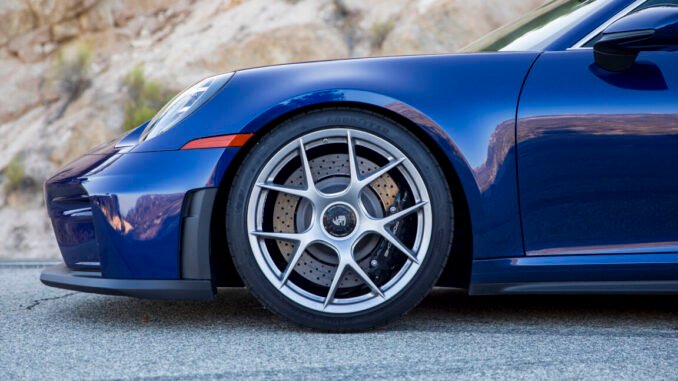
The German term means “lightweight construction,” a philosophy that is already evident in the GT3’s extensive use of weight-saving measures. In manual-equipped Touring form, the car has an official curb weight of just 3,239 pounds (1,470 kg), and the Leichtbau package takes the pursuit of lightness even further. The treatment swaps the standard roof skin, anti-roll bar, drop links, and rear-axle shear plate for carbon fiber components, trades the forged alloy wheels with forged magnesium rollers that save 19 pounds of rotating mass, replaces the standard interior door panels with lightweight units, and outfits manual-equipped examples with the shorter gear lever from the 911 S/T.
The Touring’s more road-focused mission seems to have had some influence on the 992.2 GT3’s overall tuning as well: A revised suspension strut bump-stop design allows for more spring travel than the outgoing car, thereby reducing wheel-load fluctuations and the front end’s tendency to wander over rough pavement—a change that seems largely aimed at improving the GT3’s civility on the street. The suspension remains firm, though, which is to be expected in a GT3, and badly rutted pavement can still toss you around a bit. But the latest iteration tracks straight and resists tramlining far better than you might expect from something this focused.


Be the first to comment