


With the help of the kind of light-warping that makes “invisibility cloaks” possible, scientists have developed a new kind of 3D printing that is capable of both microscopic detail and high throughput. The researchers suggest their new technique could enable the mass production of complex nanometer-scale structures. The potential applications include drug delivery and nuclear fusion research.
Currently the most precise method for 3D printing complex microscopic features is two-photon lithography. The technique uses liquid resins that solidify only when photosensitive molecules within the resin absorb two photons of light at the same time instead of just one. Two-photon lithography enables the fabrication of items with voxels—the 3D equivalent of pixels—only a few dozen nanometers in size.
However, two-photon lithography has proven too slow for large-scale practical applications. This has largely rendered it a laboratory tool to produce microscopic prototypes.
Until now, two-photon lithography has depended on conventional lenses, which have limitations that slow down the technique. Now, in a new study, Xia and his colleagues have experimented with so-called metalenses, which can bend light in unexpected ways.

Metalenses Revolutionize 3D Printing
The scientists experimented with optics made of metastructures—materials whose structures contain repeating patterns at scales that are smaller than the wavelengths of whatever the structures are designed to interact with. Optical metastructures, which include metalenses, can manipulate light in a variety of ways, resulting in devices like invisibility cloaks that can bend light around objects from light.
In the new study, the researchers created metalenses that, when intense laser light shone on them, could each serve as a miniature 3D printer. These flat metalenses could focus this light without the kinds of aberrations that can result from the curves of conventional optics. The resulting lenses can generate high resolution while also avoiding problems that can reduce throughput.
The scientists fabricated arrays that possessed up to 129,500 metalenses. Each metalens ranged from 100 to 200 micrometers wide and consisted of forests of silicon pillars, each of which was 195 nanometers long and 104 nanometers in diameter.
The new metalens-based lithography system first shines a femtosecond near-infrared laser pulse onto a spatial light modulator. The modulator shapes the laser into a pattern of light onto a metalens array, generating up to more than 120,000 focal spots on the resin underneath it to solidify it. Each metalens within the array can work independently to 3D print features. In one example, the researchers fabricated microscopic chessboards, with each roughly 100-micrometer-wide chess piece printed by a different metalens.
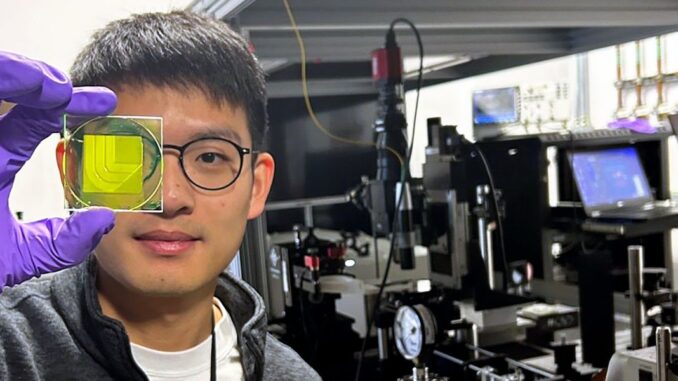
Songyun Gu holds up a metalens array that can speed up microscopic 3D printing tasks and make them more precise.Songyun Gu
Potential applications of such technology could include fabricating complex specialized targets for lasers, such as the pellets that store fuel in laser-based nuclear fusion research, says Xiaoxing Xia, a staff scientist at Lawrence Livermore National Laboratory in Livermore, Calif. Another possibility is generating millions of nanoparticles to help deliver medicines into the body and that are difficult to manufacture using other techniques.
A weakness of conventional two-photon lithography is that it’s limited to printing areas only a few hundred micrometers on a side. To create larger structures, researchers often have to stitch thousands of tiles together, which is a slow, error-prone process. The new system can print areas up to 12 square centimeters one a side, minimizing the need for stitching.
In experiments, the new system was capable of printing features as fine as 113 nanometers, which matches existing, comparable two-photon lithography systems. However, it printed those features at rates of up to 120 million voxels per second, which is roughly 1,000 times as fast as other two-photon lithography systems.
“What we demonstrated in this paper is just what we could do with limited resources in a lab setting,” Xia says. “With commercial over-the-shelf upgrades, another 100-fold throughput enhancement could be done in a relatively straightforward way.”
The scientists detailed their findings online 17 December in the journal Nature.
From Your Site Articles
Related Articles Around the Web



Be the first to comment