


Four years into a full-scale invasion and a decade after Russia’s annexation of Crimea, Ukraine’s tech ecosystem continues to flourish at home and in exile around the world. After celebrating its 10th anniversary in 2024, Ukraine’s premier tech event, IT Arena, returned to the Arena Lviv Stadium for the first time since 2019.
In September 2025, I attended the event for the sixth time (the fourth since the invasion). Over the years, I’ve watched as attendees and speakers slowly transitioned from a focus on consumer tech to an innovative emphasis on defense, security, health, and governance. In the face of adversity and necessity, Ukraine’s tech scene has not only survived, it has blossomed into an international powerhouse.
While billions of dollars slowly trickle into the country, this support often comes erratically and is accompanied by restrictions. This leads to one of the common themes in Ukrainian tech development: Locals have found inventive ways to create cheap but effective solutions to immediate problems.
The rest of the world is taking notice. Justin Zeefe, an American investor in Ukraine, explained that one of the reasons he invests in Ukraine is because its entrepreneurs are setting the standards the rest of the world will follow in the defense and dual-use sectors.

“There is a failure to understand that this war represents an evolutionary change in the way battles are fought,” says Zeefe. Warfare “is no longer about $90 million pieces of equipment that light up like a Christmas tree on the adversary’s detection systems. It’s about small- and large-volume, software-controlled, easy-to-update, electronic warfare-hardened equipment, and the U.S. industrial-military complex cannot account for that. The Ukrainians are building things that are comparable in quality, more efficiently, smaller, and cheaper, while also removing Chinese components from the supply.”
A representative of Skyfall, one of Ukraine’s biggest drone manufacturers, added, “In some ways, Ukraine can be at the forefront of innovative military development. In the West, the industry may be better, but weapons development costs 100 times more and is too slow.” (The representative, like several others interviewed for this story, asked not to be identified for security reasons.)
One example of doing more with less is Himera, the winner of IT Arena’s 2023 defense startup competition. The company now has more than 7,000 of their universal communication systems in use with the Ukrainian defense forces. The devices are designed to operate in harsh weather and electronic-warfare environments, using a mesh network to connect soldiers, robots, drones, and sensors.
“We’re operating in a market where the youngest competitor has been around for more than 20 years,” says Misha Rudominsky, a cofounder of Himera. “It’s not a stagnant market, but it hasn’t seen real change for a long time—neither in how products look and function, nor in the competitive landscape. Both users and suppliers have simply gotten used to the way things have always been done.”
Rovertech is another lean and agile company formed by engineers. In two years, they have built a range of unmanned ground vehicles, or as one of the staff described them, “machine guns on wheels.” Primarily designed to bring down drones, the typical vehicle configuration has gyroscopic stabilizers, meaning that while it has its own wheels, it can also work on the back of a truck moving over rough terrain. It can run on its own power or use a car battery, and the operator can remotely control it via an Ethernet cable, Starlink, and lidar.
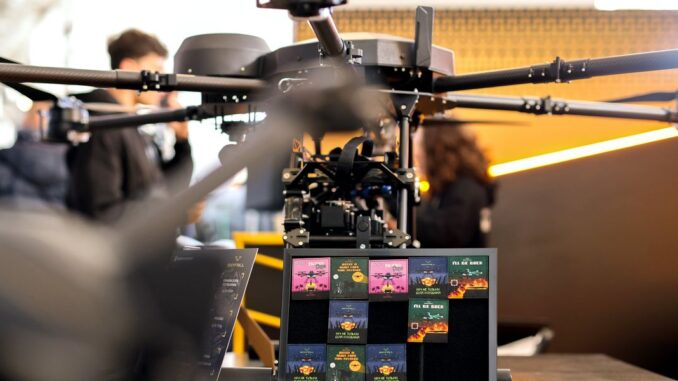
A nose and motor of Airlogix’s GOR modular reconnaissance drone system was on display at IT Arena in Lviv, Ukraine.Stefanyak Yurii
Many of these companies began as volunteer efforts to develop technology to address an immediate military need, and evolved into more commercial endeavors as they needed to scale. Barvinok-5, for example, got its start producing firmware to increase security between certain drone controllers and the drones themselves. The company then pivoted to applying tech to strengthening drone video feeds. The team took their existing knowledge from working in embedded systems and automotive electronics, as well as what they learned developing the remote-control firmware, and used it to develop an adaptive frequency-hopping and encryption system for video. The technology makes the video signals less vulnerable to signal jamming and interception.
Airlogix started in 2020, developing a cargo vertical take-off and landing (VTOL) aircraft called Hummerhead, designed to deliver payloads to hard-to-reach and rugged places. When the full-scale war began in 2022, the company pivoted to reconnaissance UAVs to meet urgent frontline needs. Over 1,000 of their aircraft are now actively supporting Ukrainian forces at the front, and Airlogix’s GOR flier is among the top reconnaissance UAVs globally.
Another hallmark of the drone war in Ukraine is autonomy—both sides are striving for higher and higher levels of autonomy, enabling drones to reach their targets even in the face of electronic jamming that renders remote control useless. One of the success stories here is Norda, which develops drone software for fully autonomous targeting. The company claims its image-stabilization system increases what an operator can see in the drone’s video feed, and therefore on-target accuracy, from 30 percent to 70 percent or more, over ranges of 2 kilometers. It accomplishes this in part by utilizing a signal repeater for video and radio communication.
Those improvements enable attacking drones to fly longer distances to their targets. Once the operator chooses the target, the drone goes fully autonomously to it. These targets typically include vehicles and forces laying mines or delivering provisions. If the drone falls into enemy hands, its battery is programmed to explode.
As one of their representatives explained, they had to find better ways to scale. “We began as a company in 2024. Previously, we were a group of volunteers, and before that, I worked as a data developer. I started volunteering with the military in 2022, helping them understand how to use thermal or night vision correctly.
“There was one moment when a lot of people were in the army, but not everybody understood how to use the technologies,” the Norda engineer continued. “We started developing drones because drones were critical. We developed, like, 200 drones per month, and when we realized that wasn’t enough, we started developing drone software instead, which we send to manufacturers. Now this means we can help develop 50,000 drones per month.”
This approach is something that Justin Zeefe endorses. “Focus on what makes you wholly distinct from your competition,” he says. “If you’re spending north of 30 percent of your company’s budget on a product that is commoditized or that everyone else is building, you are misallocating your resources.
“But if you’re building a drone and spending 50 percent of your time building the drone and 50 percent building software to control the drone or a novel gimbaling system, you can focus on that, because that is the most efficient use of your time and resources.”
From Your Site Articles
Related Articles Around the Web



Be the first to comment